

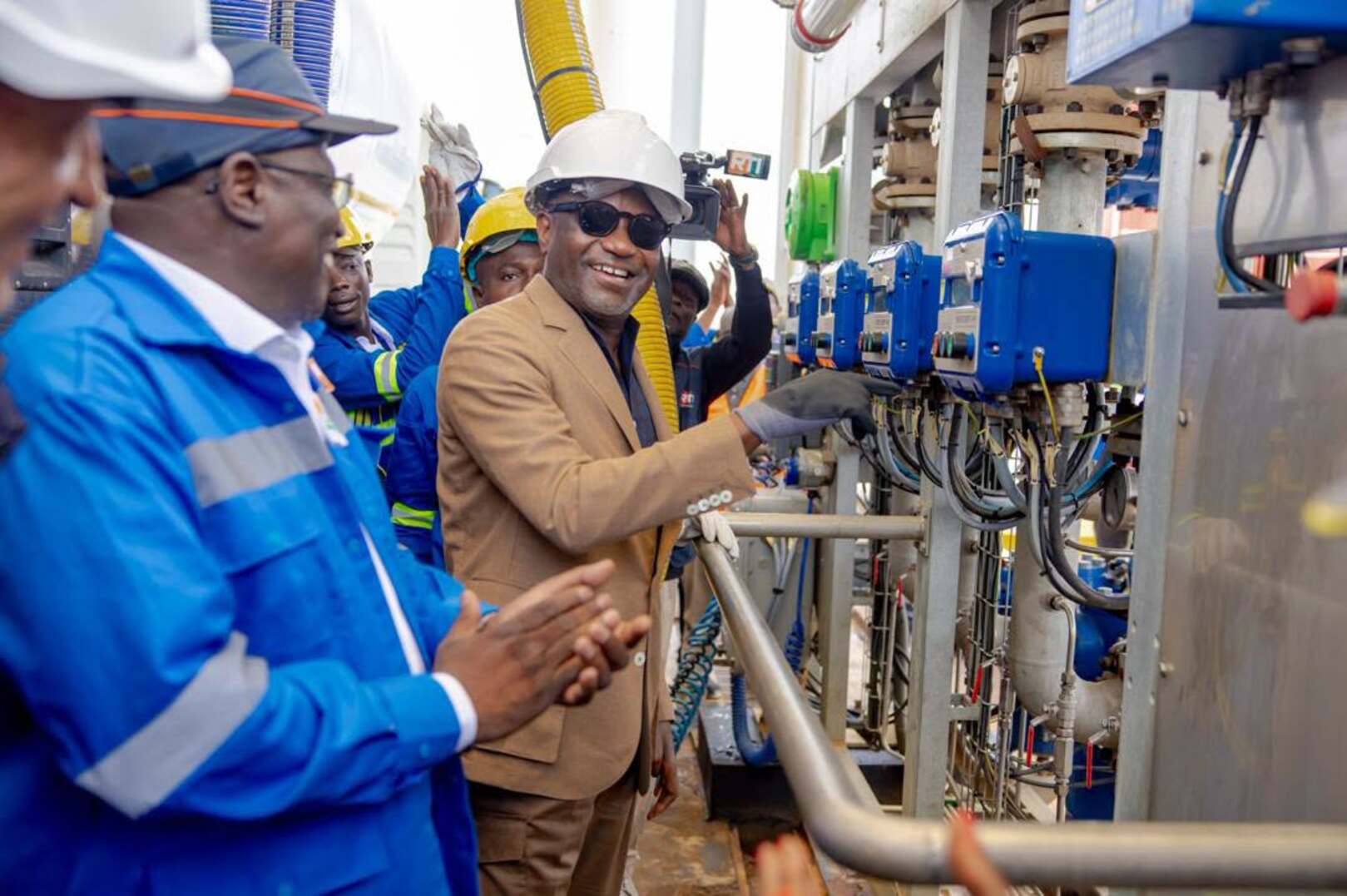
Côte d’Ivoire’s Minister of Mines, Petroleum and Energy, Mamadou Sangafowa-Coulibaly, commissioned the R14 storage tank, with a capacity of 20,000 cubic meters of diesel, as well as the country’s first truck loading facility at source operated by the Ivorian Petroleum Stock Management Company (GESTOCI) on Friday, July 24, 2026, in Yamoussoukro.
With these two major infrastructure projects, the storage capacity of the Yamoussoukro depot has increased to 100,700 cubic meters of nominal capacity, making GESTOCI the first national operator to introduce source loading for tanker trucks carrying premium gasoline and diesel. An additional 6,000-cubic-meter water tank was also built to strengthen the safety and protection of the facilities.
At the operational level, Minister Sangafowa-Coulibaly said the current loading capacity at the Abidjan and Yamoussoukro facilities stands at 650 trucks per day, with a target of reaching 1,800 trucks per day by 2030.
According to the minister, this expansion will require the removal of bottlenecks at the Ivorian Refining Company (SIR), an increase in national fuel storage capacity to 583,000 cubic meters, and the widespread adoption of source loading for more than 90% of liquid fuel volumes, supported by approximately 3,000 equipped tanker trucks.
He stressed that the transition would be implemented gradually to protect the interests of transport operators. The new system will reduce truck loading times to 15 minutes, compared with 45 minutes previously.
The minister also announced that Côte d’Ivoire plans to build a second refinery with a capacity of 170,000 barrels per day before 2040. Located in San Pedro, the facility would have a capacity nearly three times larger than the current SIR refinery. The country also plans to develop a multi-product pipeline linking Abidjan and Ferké, alongside new storage facilities in Odienné, Ferké, San Pedro, and Yamoussoukro.
Driven by recent discoveries of “world-class” hydrocarbon resources, Côte d’Ivoire is expected to become a net exporter of petroleum products by 2030. The country also aims to become the leading energy trading hub in the sub-region, exchanging the largest volumes of energy with neighboring countries, the minister said.
For his part, GESTOCI Director General Ibrahima Doumbia announced a major investment pipeline, including the construction of a 40,000-cubic-meter premium gasoline storage tank at the Abidjan depot, the rehabilitation of the Bouaké depot with a capacity of 48,000 cubic meters, and the construction of new 40,000-cubic-meter depots in Odienné and San Pedro.
Côte d’Ivoire’s energy strategy is increasingly focused on strengthening domestic fuel security, expanding storage infrastructure, and positioning the country as a regional energy hub in West Africa.