

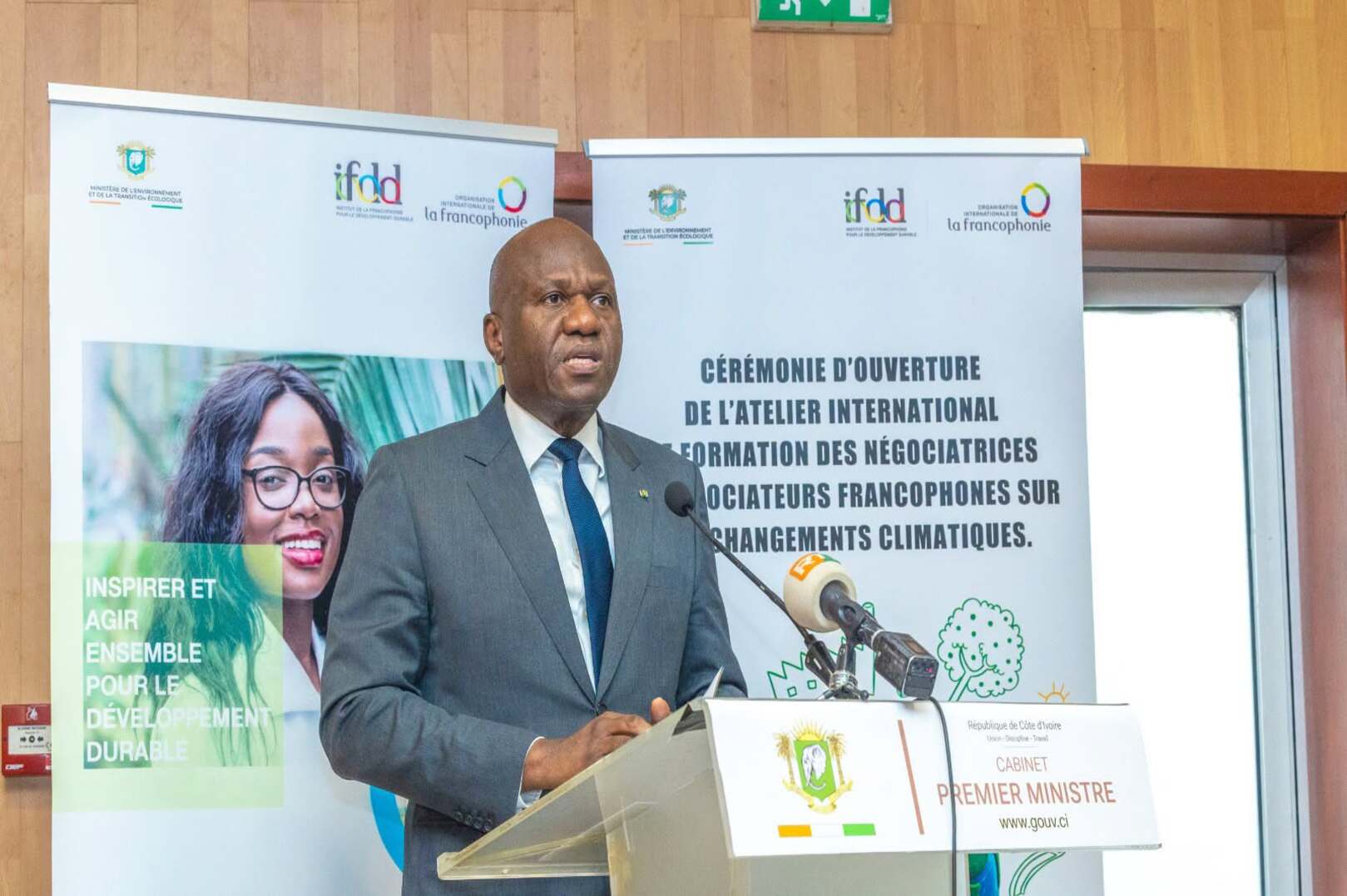
Minister of Environment and Ecological Transition Abou Bamba officially opened the international capacity-building workshop for Francophone climate change negotiators on Tuesday, September 8, 2026, at the Prime Minister’s Office Auditorium in Abidjan.
Held from September 8 to 11, 2026, the workshop, organized in partnership with the International Organisation of La Francophonie (OIF) through the Francophonie Institute for Sustainable Development (IFDD), aims to better prepare Francophone delegations for upcoming climate diplomacy milestones, particularly COP31, which will take place from November 9 to 20, 2026, in Antalya, Türkiye.
The initiative comes amid accelerating climate change impacts. According to international data presented at the workshop, 2025 ranked as the third-hottest year ever recorded, with the global average temperature approximately 1.43°C above pre-industrial levels.
Heatwaves, extreme rainfall, floods, droughts and cyclones are affecting millions of people and causing significant economic losses. These events are also exacerbating climate injustice, as countries that have historically contributed the least to global emissions are often among the most exposed to the consequences of climate change.
The adaptation financing gap highlights this situation. According to the United Nations Environment Programme (UNEP), developing countries’ annual adaptation needs could reach $310 billion to $365 billion by 2035, compared with only $26 billion in international public adaptation finance in 2023. Adaptation needs are therefore 12 to 14 times higher than available financing.
According to Minister Abou Bamba, the effectiveness of international climate action depends on countries’ ability to defend their priorities in negotiations, build alliances and contribute to compromises that are ambitious, fair and implementable. However, Francophone delegations continue to face several challenges, including the language barrier, the increasing technical complexity of negotiations, rapidly evolving texts, frequent turnover among negotiating teams, and sometimes limited access to specialized expertise in French.
“The ambition of this workshop is therefore to strengthen your technical, strategic and operational capacities, in order to increase the influence of Francophone negotiators in the multilateral climate process,” he told the negotiators.
Over the four-day workshop, participants will explore issues including adaptation, mitigation, climate finance, loss and damage, transparency, technology, just transition, agriculture, carbon markets, as well as follow-up to the first Global Stocktake.