

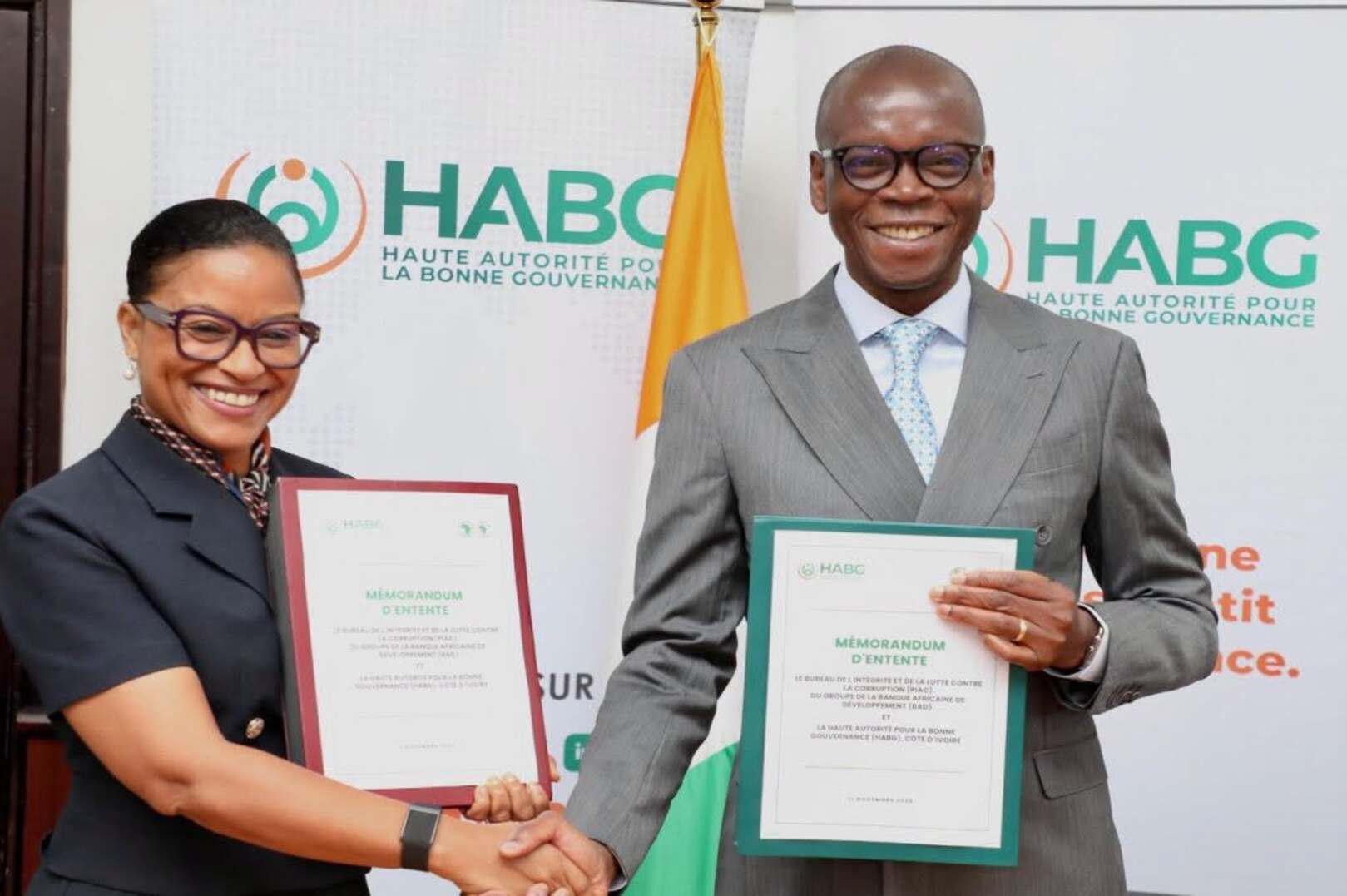
Côte d’Ivoire’s High Authority for Good Governance (HABG) and the African Development Bank Group (AfDB) have signed an agreement to strengthen efforts to prevent, detect and investigate fraud and corruption, particularly in development projects financed by the bank.
The memorandum of understanding was signed on Wednesday, November 11, 2026, at the HABG headquarters in Abidjan, between the Ivorian institution and the bank’s Integrity and Anti-Corruption Office (PIAC).
The signing ceremony was chaired by HABG President Épiphane Zoro Bi Ballo, alongside Paula Santos da Costa, Director of the AfDB’s Integrity and Anti-Corruption Office.
The agreement establishes a framework for technical cooperation, expertise sharing and joint initiatives aimed at improving the protection of financial resources allocated to development projects in Côte d’Ivoire.
Under the partnership, the two institutions plan to organise specialised training in investigative techniques, exchange experience in data analysis and strengthen their ability to identify and assess potential cases of fraud and corruption.
The AfDB will also provide expert support to Côte d’Ivoire’s Academy of Good Governance and Anti-Corruption Leadership (ABG-LAC), particularly through training activities covering compliance, integrity due diligence and whistleblowing policies.
The memorandum further provides for increased information sharing to help identify risks, verify relevant information and prevent suspected cases of fraud or corruption involving AfDB-funded operations in Côte d’Ivoire.
Speaking at the ceremony, Zoro Bi Ballo said the effectiveness of the agreement would depend on its practical implementation. He called on both institutions to identify priority actions and establish mechanisms to monitor progress and assess results.
For her part, Santos da Costa said the partnership would bring together the institutions’ respective expertise while respecting their separate mandates, rules and procedures. She also proposed developing a joint roadmap and organising regular meetings between their teams.
The cooperation is expected to extend beyond investigations to include joint seminars, awareness campaigns, institutional exchanges and research into corruption trends, risks and methods.
To coordinate implementation, each institution is expected to designate focal points responsible for facilitating exchanges and monitoring agreed activities.
The agreement does not transfer the investigative powers of either institution to the other. Their cooperation will operate within their respective legal frameworks and existing procedures.
Through the partnership, the HABG and the AfDB aim to strengthen institutional capacity, improve transparency and ensure that resources allocated to development projects are used for their intended purposes.