

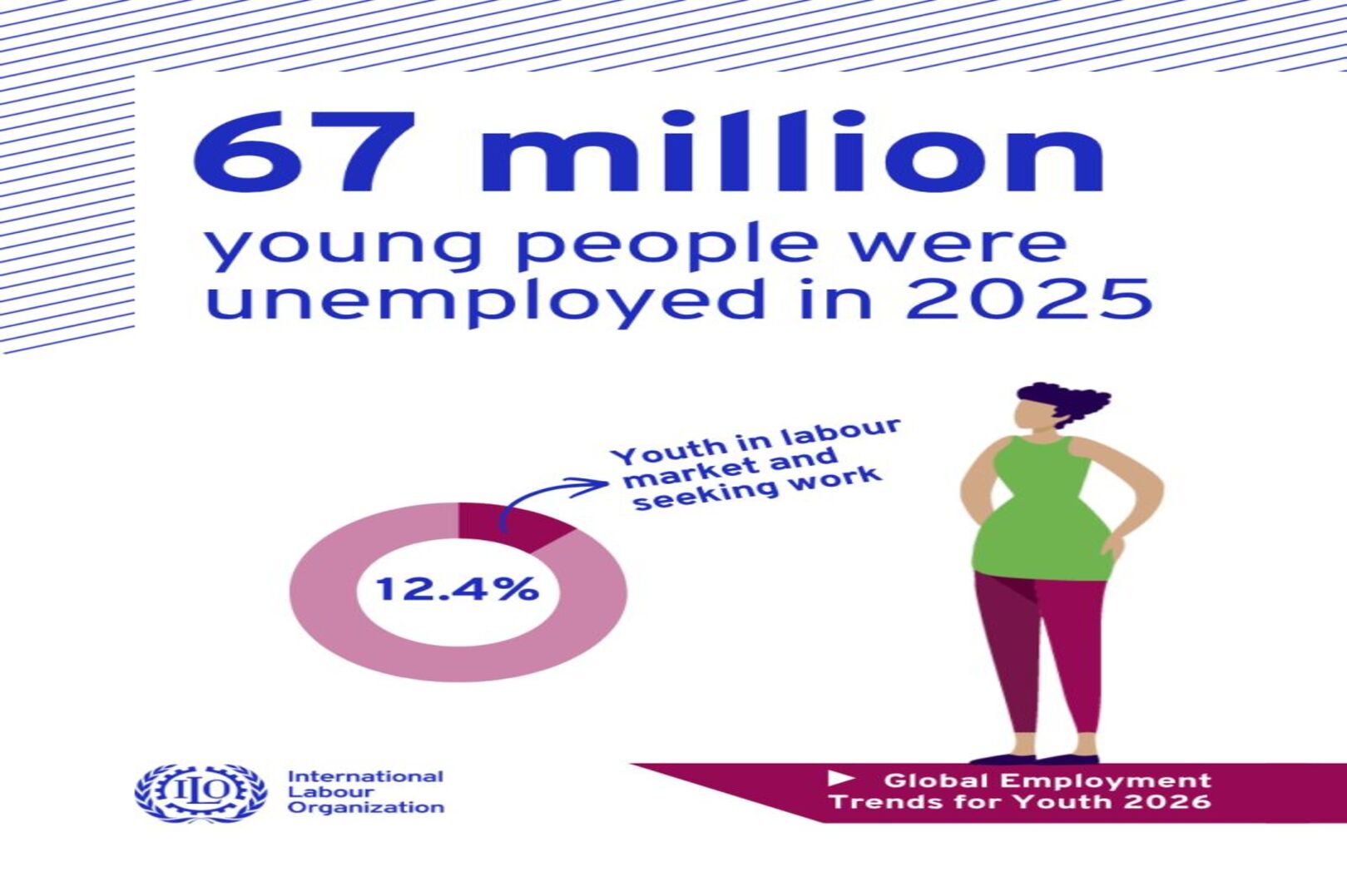
Global youth unemployment rose to 12.4% in 2025, leaving around 67 million people aged 15 to 24 without work, according to the International Labour Organization.
The increase marks a reversal of the improvements recorded in youth labour markets following the COVID-19 pandemic, as slower economic growth, geopolitical tensions and weak job creation make it harder for young people to enter the workforce.
The wider picture is even more concerning. The share of young people who are not in employment, education or training — known as NEET — reached 20% in 2025, representing more than 257 million young people worldwide.
Youth unemployment increased between 2023 and 2025 in eight of the world’s 11 subregions, according to the ILO.
Artificial intelligence is adding another layer of uncertainty to the outlook. The ILO estimates that 6.1% of jobs held by people aged 15 to 29 are in occupations highly exposed to AI-related changes.
The organisation warns that if just 10% of these exposed jobs were to disappear entirely, around 5.6 million young workers could face unemployment, occupational transitions or withdrawal from the labour market.
However, the ILO stresses that exposure to AI does not necessarily mean that jobs will disappear. In many cases, technology is expected to transform tasks and require workers to develop new skills.
At the same time, traditional entry-level positions in clerical and administrative work, sales, services, manufacturing and some technical occupations are declining, making it more difficult for young people to establish themselves in the labour market.
High-skilled sectors such as science, engineering, healthcare and information technology, meanwhile, continue to generate employment opportunities in many countries.
Africa faces a particular challenge.
In sub-Saharan Africa, youth unemployment stands at 8.4%, below the global average. But the relatively low rate masks widespread informal employment and economic insecurity.
Many young Africans cannot afford to remain unemployed and instead enter informal or low-productivity activities to earn an income.
In low-income and lower-middle-income countries, nearly nine out of 10 young workers are employed informally, often without stable incomes, social protection or adequate job security.
The share of young people who are neither working, studying nor receiving training is also high in sub-Saharan Africa, reaching 21.6%.
The figures highlight the limitations of using unemployment alone to measure the health of African labour markets. A young person working in an informal or low-paid activity is counted as employed even when the job offers little stability or opportunity for advancement.
For governments, the challenge is therefore not only to create more jobs, but to create decent, productive and sustainable employment.
The rapid development of artificial intelligence makes the issue even more urgent. Countries will need to invest in education, vocational training and digital skills while ensuring that technological transformation does not deepen existing inequalities.
For Africa’s rapidly growing youth population, the stakes are particularly high. The ability to provide young people with quality employment and relevant skills will have major implications for economic growth, social stability and the continent’s participation in the digital economy.
The latest ILO figures point to a broader challenge: the future of youth employment will depend not simply on how many jobs are created, but on whether those jobs provide stability, protection and opportunities in an economy increasingly shaped by technology and artificial intelligence.