

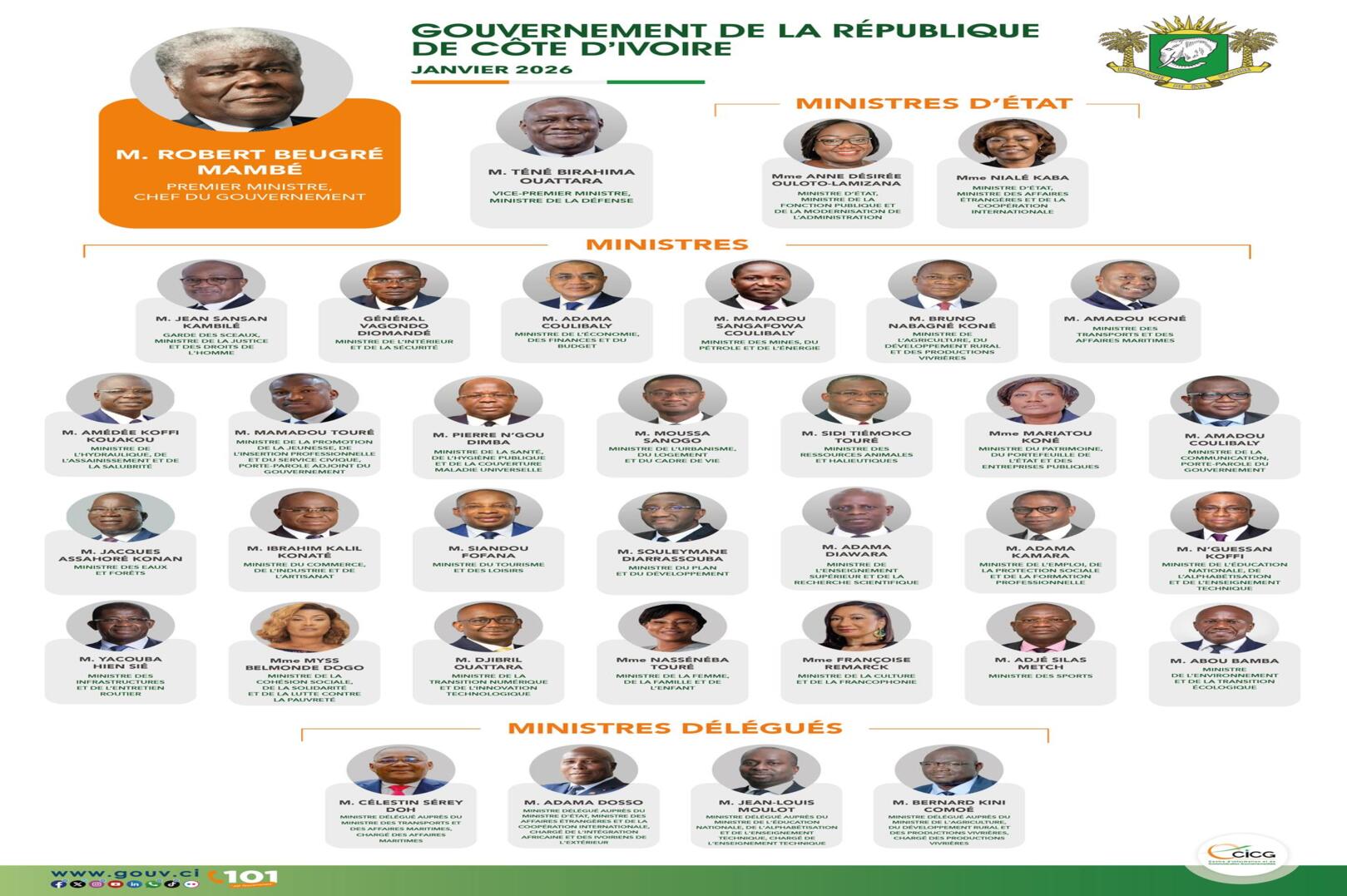
The President of the Republic, Alassane Ouattara, announced on Friday the formation of a new government, following the resignation of the previous cabinet after the December 2025 legislative elections. Robert Beugré Mambé has been reappointed as Prime Minister and Head of Government.
The new executive team is made up of 34 members, including one Vice-Prime Minister, two Ministers of State, ministers with full portfolios, and delegated ministers. This composition reflects a desire for continuity in government action, while introducing some sectoral adjustments.
Among the key appointments is that of Téné Birahima Ouattara, who has been promoted to Vice-Prime Minister and Minister of Defence, a newly created position. Nialé Kaba remains Minister of State in charge of Foreign Affairs, African Integration and Ivorians Abroad, while Anne Désirée Ouloto retains her position as Minister of State responsible for the Civil Service and Administrative Modernisation.
The core sovereign ministries remain largely unchanged. General Vagondo Diomandé continues as Minister of the Interior and Security, and Jean Sansan Kambilé retains the portfolio of Justice and Human Rights. On the economic front, Adama Coulibaly has been reconfirmed as Minister of Finance and Budget, while Mamadou Sangafowa Coulibaly remains in charge of Mines, Petroleum and Energy.
The government also includes delegated ministers, tasked with supporting ministers with full portfolios in key sectors. These appointments are intended to strengthen the effectiveness of government action and ensure closer monitoring of public policies, particularly in the areas of the economy, public administration, infrastructure and local development.
The new cabinet also features several new entrants, notably in the sectors of infrastructure, digital transformation and the environment, highlighting the authorities’ focus on modernisation, innovation and sustainable development.
Overall, the new government appears to be one of continuity, with a broad retention of outgoing ministers. It aligns with the President’s political agenda, which prioritises institutional stability, the continuation of economic reforms and improved governance.
The Prime Minister’s forthcoming policy statement before the National Assembly is expected to clarify the priorities and strategic orientations of this new government team.