

The year 2025 was one of the most remarkable in the transformation of the Ivorian education system. Under the leadership of Mariatou Koné, Minister of National Education and Literacy, Ivorian schools continued their profound transformation, driven by structural reforms, sustained investments, and improved governance.
This momentum is based on the progressive and coherent implementation of the recommendations from the General States of National Education and Literacy (EGENA), which serve as the foundation for the sector’s overhaul.
Exam Results Show Significant Improvement
The performance recorded in national examinations reinforces this direction. The CEPE (Primary School Certificate) pass rate reached 86.58%, up 3.12 points compared to the previous year. At the BEPC (Middle School Certificate) level, the increase was even more significant, with a national rate of 51.41%, up 11.23 points. The Baccalaureate achieved a 40.15% pass rate, an increase of nearly 6 points.
Modern Infrastructure and Structured Programs
The 2024–2025 school year was also marked by major infrastructure achievements. Through the Program to Support the Transformation of Basic Education (PATEB), funded by the Global Partnership for Education (GPE) and implemented with UNESCO, the government strengthened access, quality, and governance in basic education.
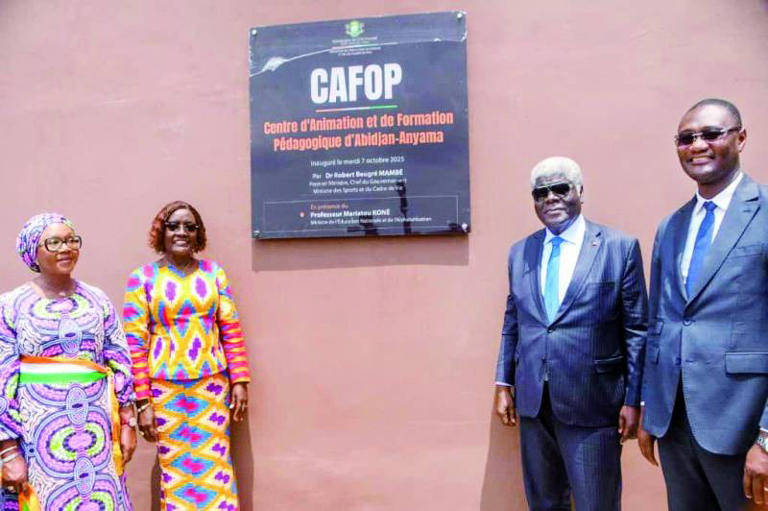
The Program for Strengthening the Basic Education System (PRESEB) complements these efforts by training teachers, providing educational materials, and integrating school health initiatives. These actions enabled the construction and rehabilitation of numerous classrooms nationwide, the inauguration of the Higher CAFOP of Anyama, the largest in West Africa, and the Dominique Ouattara Girls’ Excellence High School in Sinématiali, as well as ongoing projects in Abengourou.
At the same time, campaigns to raise awareness against teen pregnancies in schools, the distribution of school kits, strengthened social dialogue with teacher unions, and increased efforts to combat illiteracy have consolidated these achievements.
The 2024–2025 school year confirms the momentum of Ivorian education reform, with strong actions at both the primary and secondary levels. As in previous years, the CAFOP entrance exam allowed for the recruitment of 5,000 new teachers.
At the secondary level, in addition to resources provided by the public service via the École Normale Supérieure (ENS), the government conducted an exceptional recruitment of 2,885 contractual teachers in various disciplines to meet demand. Among major innovations is the installation of “Girls’ Rooms” in several schools.
Governance and Pedagogical Reforms
The reform of COGES (School Management Committees), improved financial management, and promotion of accountability have contributed to more effective school governance. On the pedagogical front, the National Program for Improving Early Learning (PNAPAS) has strengthened fundamental skills starting at the primary level.
Inclusive education remains a priority, with support for children with disabilities and, for the first time, the development of specialized textbooks. The National Textbook Scholarship (BONAMAS) provides Ivorian students with the necessary school textbooks.
Digitalization, one of the pillars of EGENA, has seen significant acceleration with the “My School at Home” platform, the creation of the Integrated Education Management System (SIGE), and the deployment of virtual classrooms.