

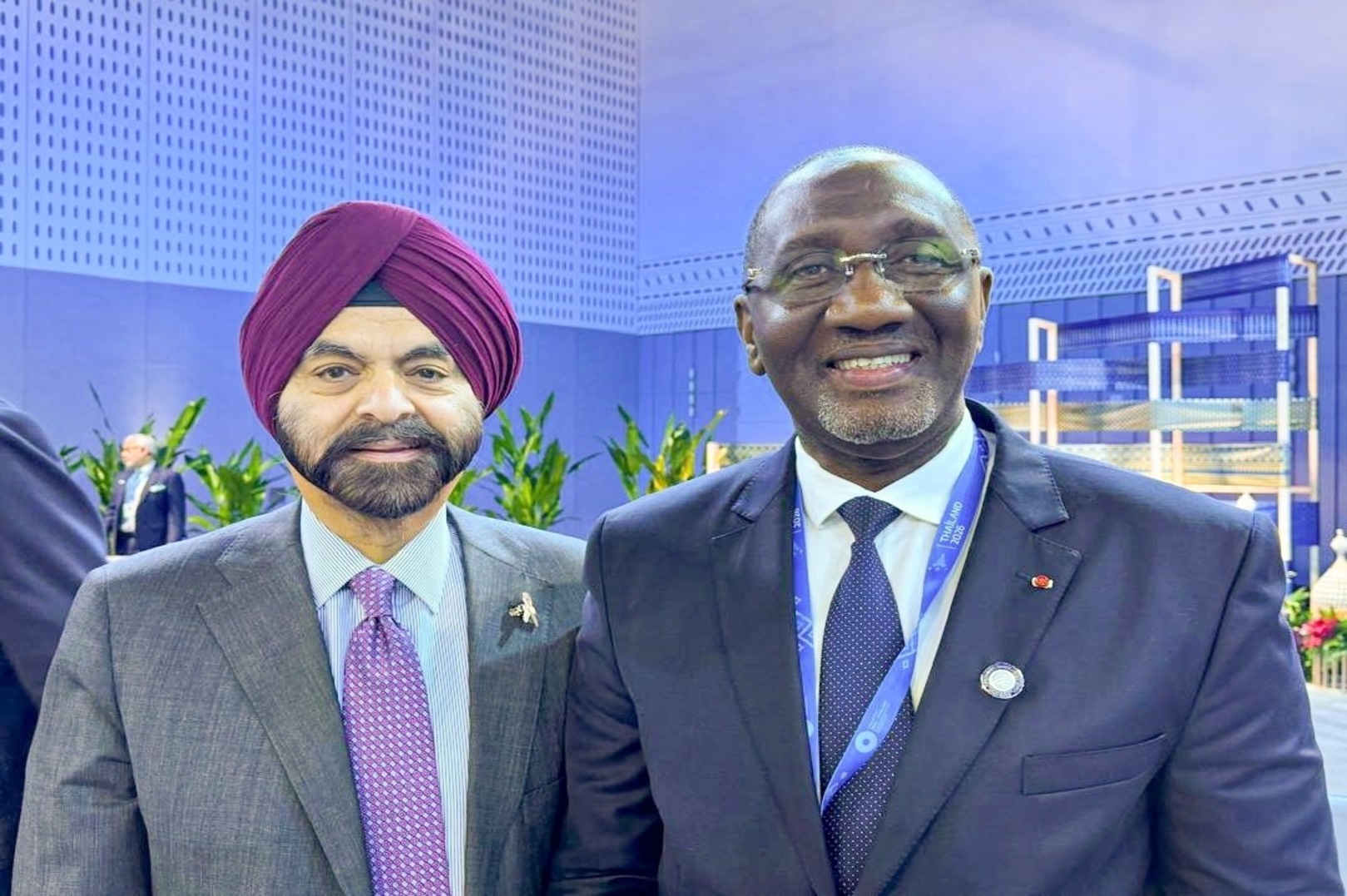
World Bank Group President Ajay Banga has highlighted Côte d’Ivoire’s debt-for-development swap as an example of how African countries can reduce borrowing costs and redirect savings towards priority sectors.
Speaking to African governors on Wednesday, October 14, 2026, during the African Caucus meeting in Bangkok, Banga discussed ways to attract more private investment to emerging and developing economies amid declining development assistance.
The meeting took place on the sidelines of the annual meetings of the World Bank Group and the International Monetary Fund. Côte d’Ivoire was represented by Planning and Development Minister Souleymane Diarrassouba, who serves as the country’s governor at the World Bank.
The debt-swap mechanism allows a country to refinance more expensive debt with new bonds backed by guarantees from the International Bank for Reconstruction and Development (IBRD) and the Multilateral Investment Guarantee Agency (MIGA), potentially securing more favourable financing terms.
The savings generated are earmarked for previously identified development priorities rather than being channelled into the general budget. These may include education, healthcare, access to drinking water and environmental protection.
According to the information presented at the meeting, 14 countries are currently working with the World Bank on similar operations.
Banga also reported that private capital mobilised for emerging and developing economies reached a record $112 billion in the 2026 financial year, up from $35 billion in 2022. However, only $3 billion went to the poorest countries, highlighting the continued difficulty of attracting investment to economies with the greatest financing needs.
He attributed part of Africa’s higher borrowing costs to the risk premium associated with the continent, noting that credit-rating agencies are particularly sensitive to unpredictable public policies. He also pointed to the World Bank’s Global Emerging Markets Risk Database, known as GEMS, as a tool to improve transparency and access to information on investment risks.
To attract more private capital, Banga called for stable regulatory frameworks, local-currency financing, stronger guarantees and the bundling of projects into asset classes that can attract pension funds and insurers. Debt-for-development swaps were also identified as one of the available financing tools.
On youth employment, he argued that governments must provide the foundations for private-sector growth, including digital connectivity, roads, reliable energy and education.
African governors at the meeting also discussed structural economic transformation, agro-industry, financing for micro, small and medium-sized enterprises, access to regional and international markets, domestic revenue mobilisation and vocational training.
With official development assistance under pressure, Banga urged African countries to support efforts to replenish the International Development Association (IDA) for its 22nd funding cycle. He said each dollar contributed could generate a leverage effect of four dollars in financing.
The discussions underscored the challenge facing African economies: mobilising sufficient funding for development while reducing financing costs and creating conditions for private investment to support industrialisation and job creation.