Africa attracts $70 billion in foreign investment in 2025 despite global uncertainty
Africa attracted approximately $70 billion in foreign direct investment (FDI) in 2025, down from the exceptional $94 billion recorded a year earlier. Despite the decline, the continent posted its third-best performance since 1990, highlighting sustained investor interest in energy, infrastructure and critical minerals, according to the World Investment Report 2026 published by the United Nations Conference on Trade and Development (UNCTAD).
The decline in FDI flows does not reflect a loss of investor confidence, the UN agency said. The exceptionally high figures recorded in 2024 were driven by a limited number of unusually large transactions. In 2025, FDI inflows remained nearly one-third above Africa’s long-term average, while companies continued to announce new investment projects despite a global environment marked by geopolitical tensions and trade policy uncertainty.
Egypt remains the leading destination, Guinea emerges as a surprise
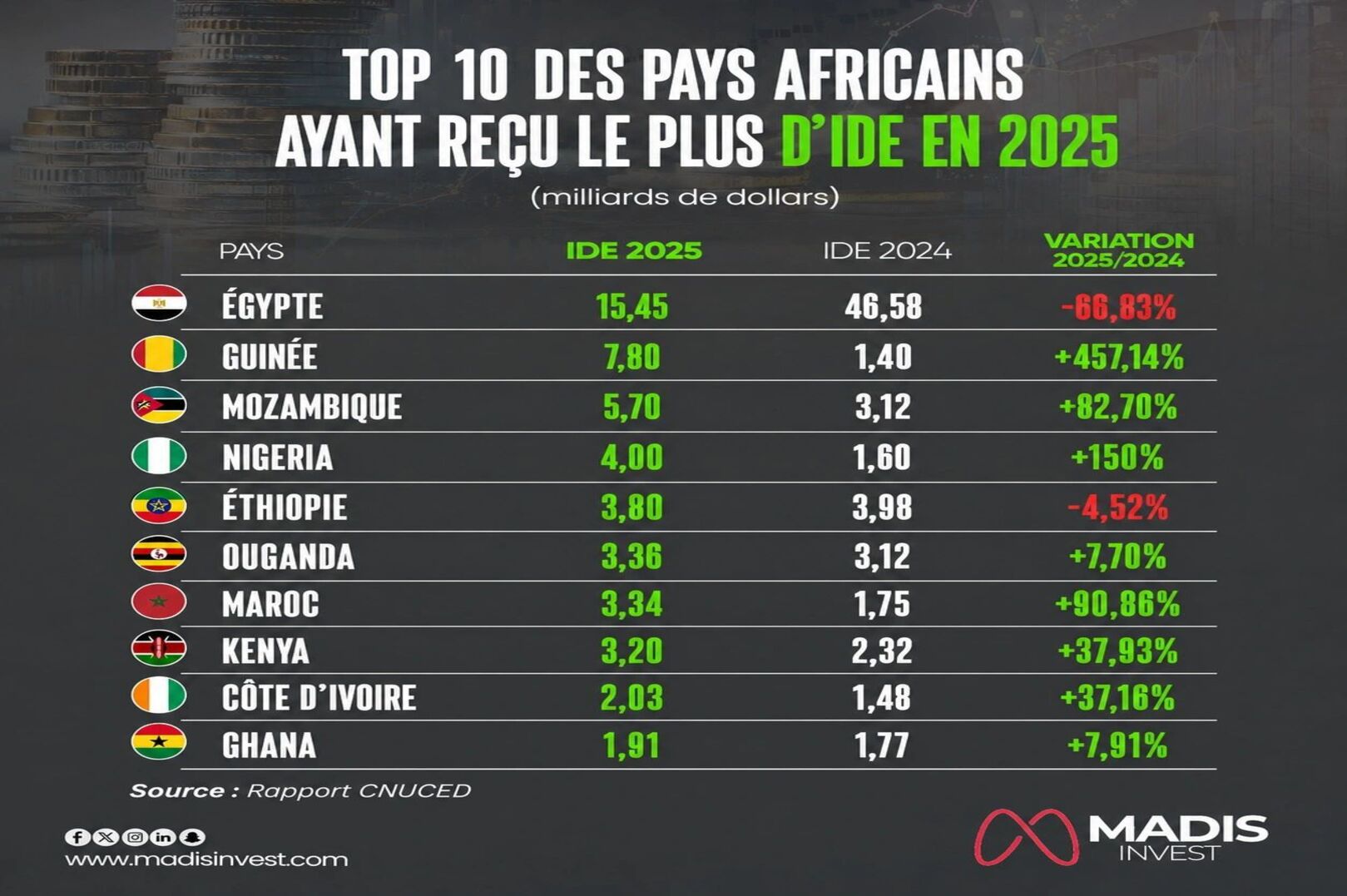
Egypt retained its position as Africa’s largest recipient of foreign direct investment, attracting $15.45 billion, ahead of Guinea ($7.8 billion) and Mozambique ($5.7 billion), according to UNCTAD data. However, Egypt’s performance reflects a sharp correction, with FDI falling 66.83% from the record $46.58 billion received in 2024, when several large-scale transactions pushed inflows to an unprecedented level.
By contrast, Guinea recorded the strongest growth among Africa’s leading destinations. FDI inflows increased more than fivefold, rising from $1.4 billion to $7.8 billion, a 457.14% increase, driven by investments in mining projects and related infrastructure.
Mozambique continued its strong momentum, with FDI rising 82.7% to $5.7 billion, supported primarily by natural gas developments. Nigeria also staged a strong recovery. Africa’s largest economy attracted $4 billion in foreign investment, up from $1.6 billion a year earlier, representing a 150% increase.
Ethiopia was the only major investment destination to record a decline, with FDI slipping 4.52% to $3.8 billion. The remainder of the top ten included Uganda ($3.36 billion), Morocco ($3.34 billion), Kenya ($3.2 billion), Côte d’Ivoire ($2.03 billion) and Ghana ($1.91 billion), all of which recorded increases in investment inflows.
Ranked ninth on the continent, Côte d’Ivoire saw FDI increase by 37.16% compared with 2024, reinforcing its growing attractiveness to international investors.
More projects despite lower investment values
Beyond headline FDI figures, UNCTAD highlighted a shift in the nature of investments. The total value of announced greenfield projects declined by nearly one-third in 2025, while the number of projects announced continued to rise.
“FDI flow figures tell only part of the story,” the report said, adding that the trend “suggests companies continue committing capital to future projects despite geopolitical tensions, trade policy uncertainty and a more selective global investment environment.”
According to UNCTAD, greenfield investment projects often provide “a clearer indication of the long-term opportunities identified by investors” than one-off mega deals, which can significantly distort annual FDI statistics.
Gulf and Asian investors gain ground
The report also highlights the growing role of investors from Gulf countries and several Asian economies. Their investments are increasingly concentrated in energy, infrastructure, logistics, real estate and transport. This trend reflects the gradual diversification of Africa’s sources of investment financing at a time when global competition for capital continues to intensify.
Critical minerals drive investment
Rising global demand for critical minerals is also strengthening Africa’s investment appeal. Investors are increasingly targeting countries with reserves of copper, cobalt, lithium, graphite, manganese and rare earth elements, which are essential for manufacturing batteries, electric vehicles and technologies supporting the global energy transition.
Africa’s least developed countries received approximately $33 billion in FDI in 2025. However, these inflows remain heavily concentrated in a limited number of resource-rich economies or countries undertaking major energy and industrial projects.
Turning FDI into industrial development
For UNCTAD, Africa’s greatest challenge is no longer simply attracting foreign investment, but converting those investments into sustainable economic development.
“The real prize lies in capturing a greater share of the value created around these investments through processing, manufacturing, services and stronger regional supply chains,” the report said.
UNCTAD argues that achieving this objective will require improved infrastructure, skilled labor, stronger industrial capabilities and policies that support project preparation, risk sharing, reliable energy supply, efficient transport networks, local supplier development and domestic processing of natural resources where economically viable.
“The success of Africa’s next stage of development will depend not only on the volume of investment it attracts, but also on its ability to translate those investments into jobs, technology transfer, industrial upgrading and economic diversification,” the report concludes.