

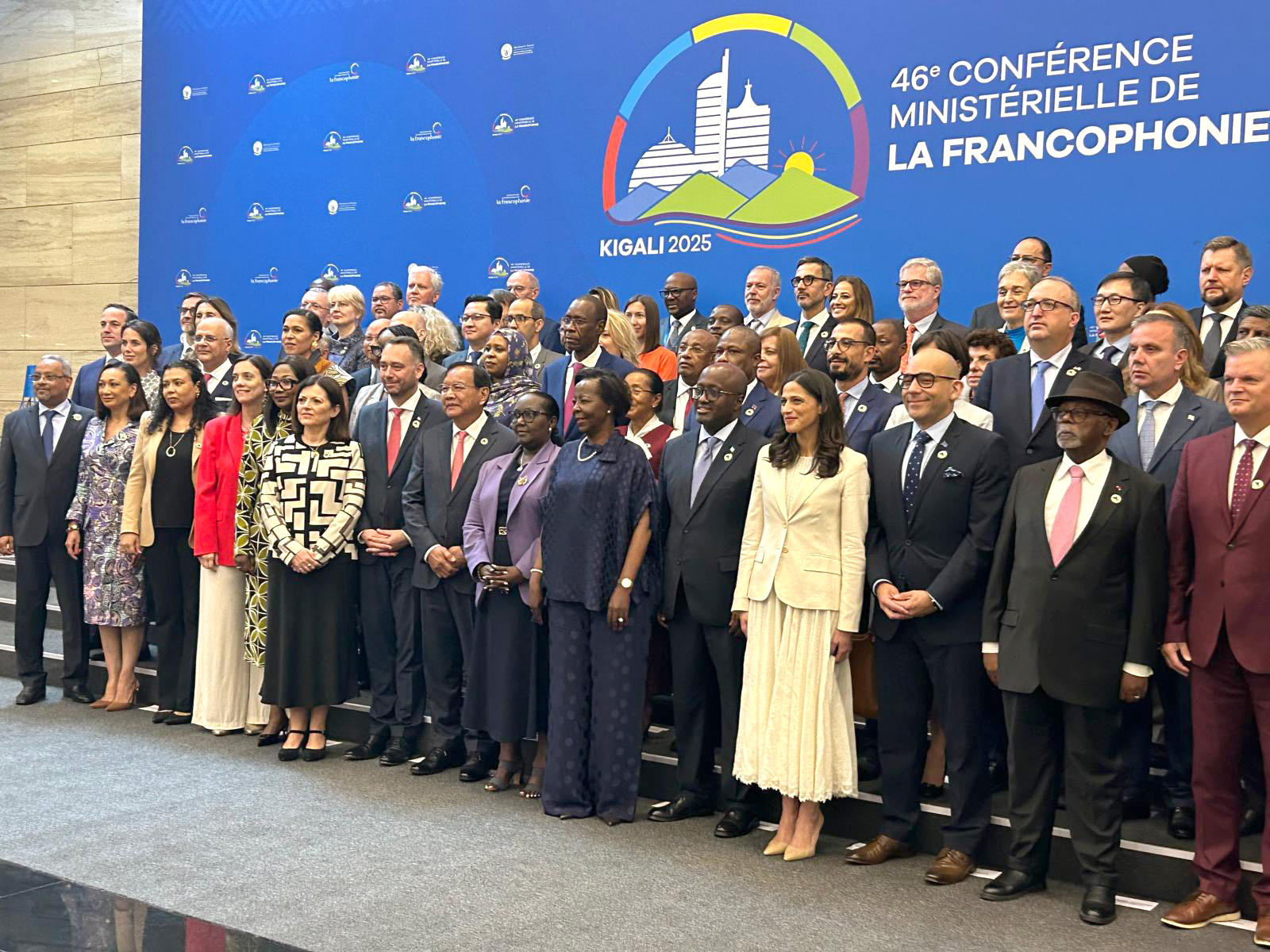
Côte d’Ivoire Reaffirms Commitment to Inclusion and Women’s Empowerment at CMF
Côte d’Ivoire, represented by its Minister of Culture and Francophonie, Françoise Remarck, reaffirmed its commitment to inclusion and the full empowerment of women within the Francophone space. This was on Wednesday, November 19, 2025, in Kigali, at the opening of the 46th Ministerial Conference of La Francophonie, held in the Rwandan capital on November 19 and 20, under the theme: “Thirty (30) Years After the Beijing Conference: The Contribution of Women within the Francophone Space.” The event took place in the presence of the Secretary-General of the International Organisation of La Francophonie (OIF), Louise Mushikiwabo.
For the second consecutive time, Côte d’Ivoire has been selected to assume the Vice-Presidency of the CMF—recognition of the exemplary work carried out within the Francophonie, where the country ranks as the fourth-largest Francophone nation.
“Francophonie reminds us that gender is not an option but an imperative,” stated Françoise Remarck as she presented the case of Côte d’Ivoire. “Today, here in Kigali, Côte d’Ivoire reaffirms its commitment to a Francophone space built on more inclusive policies for women and their full empowerment,” she emphasized.
To that end, the country has ratified all major instruments, including the Convention on the Elimination of All Forms of Discrimination Against Women (CEDAW), the Beijing Platform for Action, the Sustainable Development Goals, and the Francophonie Declaration on Gender Equality.
Continuing her address, Minister Françoise Remarck—head of the Ivorian delegation to the Land of a Thousand Hills—highlighted that under President Alassane Ouattara, Côte d’Ivoire has significantly strengthened its normative framework. Key reforms include laws guaranteeing gender equality in family matters, inheritance, and marriage; the criminalization of rape; enhanced measures against gender-based violence; the revision of the National Gender Policy in 2023; and the establishment of a minimum quota of 30% women on electoral lists.
She recalled that the Women’s Support Fund of Côte d’Ivoire (FAFCI), created in 2012 by First Lady Dominique Ouattara, the National Women and Development Fund (FNFD), the Women’s Initiative and Economic Capacity Development Program, the Women’s Empowerment and Demographic Dividend Project, and other innovative mechanisms have mobilized nearly 100 billion CFA francs and supported over 400,000 women-led projects.
Significant progress has also been made in women’s representation: 27% in the National Assembly and 22.25% in the Senate, which, for the first time, is led by a woman—Kandia Camara. The literacy rate of young girls rose from 47% to 53% since 2015, and military and technical schools have been opened to female students.
These reforms have led to Côte d’Ivoire being recognized by the Organisation for Economic Co-operation and Development (OECD) through its 2023 Social Institutions and Gender Index (SIGI) report as a continental leader for progress in gender equality, women’s empowerment, and the reduction of discriminatory barriers to resources and civil liberties.
“Thirty years after Beijing, Côte d’Ivoire is moving forward with determination, having integrated gender equality and the promotion of women’s skills into its public policies—not only as a right, but as a real driver of peace for sustainable and equitable development,” affirmed Françoise Remarck.
The 46th Ministerial Conference of La Francophonie concluded on Thursday, November 20, 2025, in Kigali. Côte d’Ivoire was represented by Minister Françoise Remarck, Minister in charge of Francophonie, and by Ambassador Maurice Bandaman, Personal Representative of the President to the Francophonie, after the Minister returned to Abidjan on the morning of November 20 to attend a session at the National Assembly on Friday, November 21.
A highlight of the Conference was the handover of the presidency from France to Cambodia, which will host the next Summit from November 14 to 16, 2026, in the city of Siem Reap, near the Angkor site, a UNESCO World Heritage location. The chosen theme for the next Summit is “Peace as a Driver of Sustainable Development.”
The closing session was also marked by a standing ovation for Secretary-General Louise Mushikiwabo, whose term is ending soon, and by discussions on the eligibility criteria for the 2026 election. Côte d’Ivoire officially announced its support for the Secretary-General for a new mandate, which it plans to endorse. Several other countries likewise encouraged her to run again.
The Secretary-General has combined rigor with bold reforms, giving priority to dialogue in response to crises affecting the Francophone world. Multilingualism remains a strength of the Francophonie, along with its various programs, particularly those targeting women and teachers. The OIF must, however, continue adapting to diverse and sometimes unexpected global shifts. The Kigali Declaration calls on States and Governments to strengthen data collection on gender equality and ensure the protection and participation of women in all sectors.
As a reminder, on November 18, the Minister in charge of Francophonie held a bilateral meeting with her counterpart from Quebec, Minister Christopher Skeete, focusing on key issues including youth training, employability, digital sovereignty, and broader cooperation between both regions.