Côte d’Ivoire Becomes the Main Driver of SMB’s Bitumen Business in 2025 Despite Production Challenges
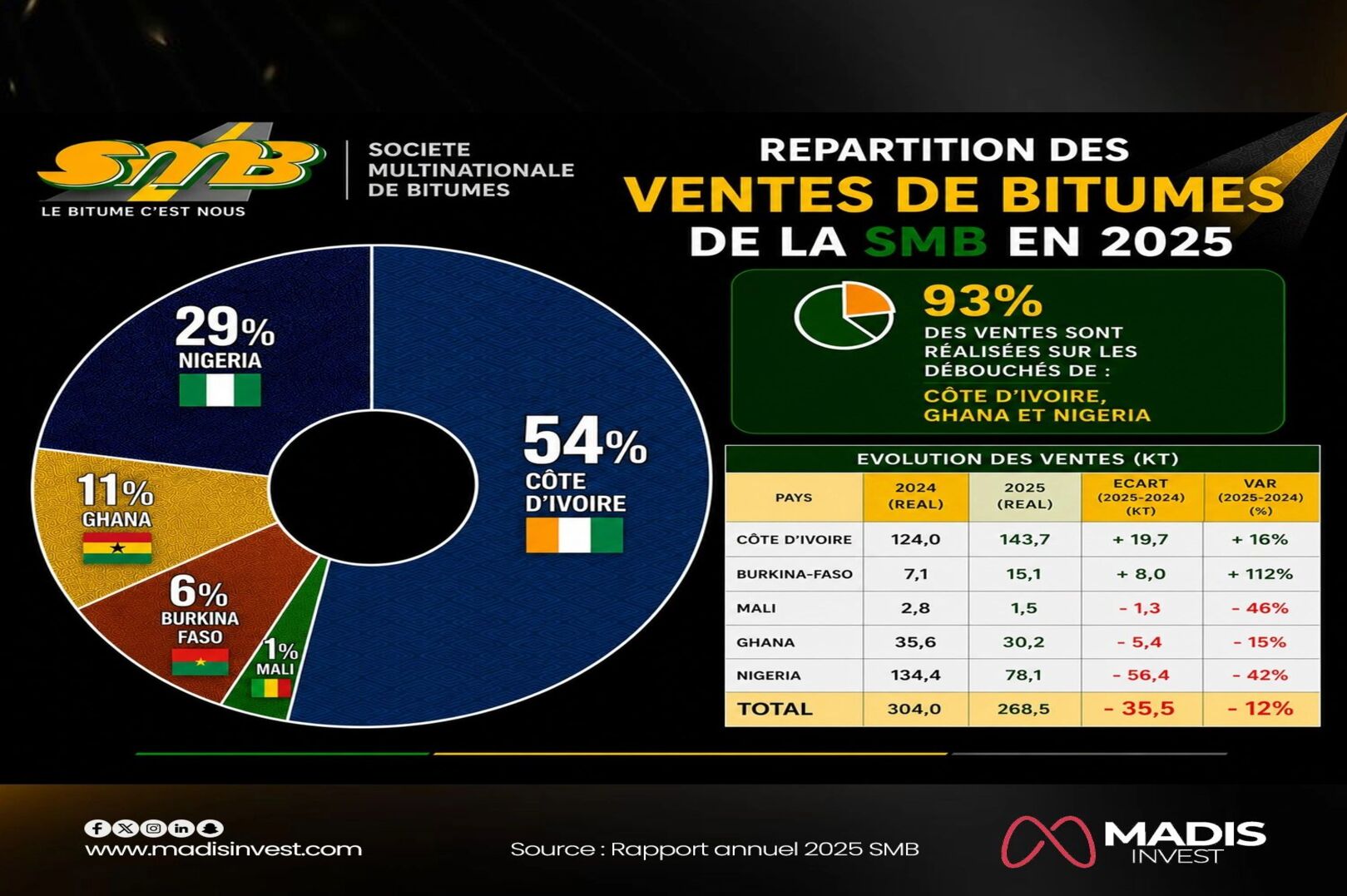
The Ivorian market remained the primary growth engine for the Société Multinationale de Bitumes (SMB) in 2025. Despite a decline in production and lower exports, Côte d’Ivoire accounted for 54% of the company’s total bitumen sales, a significantly larger share than in the previous year.
According to the company’s financial results, total bitumen sales reached 268.5 kilotonnes (KT) in 2025, compared with 304 KT in 2024, representing a 12% decline. Bitumen now accounts for 52% of SMB’s total sales, while the remaining 48% comes from distillate products.
The geographical distribution of sales highlights the growing importance of the Ivorian market. SMB sold 143.7 KT of bitumen in Côte d’Ivoire in 2025, up 16% from 124 KT in 2024. This increase was driven by sustained demand generated by the country's numerous road construction and rehabilitation projects. As a result, revenue generated in the domestic market increased by 10%, rising from CFA 58.11 billion to CFA 63.85 billion.
Côte d’Ivoire therefore represented more than half of SMB’s bitumen sales, while maritime exports accounted for 40% and other land-based markets represented 6%.
Nigeria remained SMB’s second-largest market, with 78.1 KT of bitumen sold. However, deliveries to the country declined by 42%, representing a reduction of 56.4 KT compared with the previous year. Ghana ranked third with 30.2 KT, down 15% from 2024.
Burkina Faso emerged as the standout performer during the year. Sales more than doubled to 15.1 KT, representing a remarkable 112% increase, supported by the completion of major infrastructure projects, including National Road 14 (RN14) and three toll stations inaugurated in October 2025.
Conversely, sales to Mali declined to 1.5 KT, compared with 2.8 KT a year earlier, a 46% decrease, despite continued work on the Sandaré–Diéma road and National Road 27 (RN27).
Overall, Côte d’Ivoire, Nigeria, and Ghana accounted for 93% of SMB’s total bitumen sales, underlining the company’s heavy commercial dependence on these three markets.
Industrial constraints weighed on exports
The shift in sales distribution was largely the result of industrial challenges faced during the year. Maritime exports fell from 170 KT in 2024 to 108.2 KT in 2025, a 36% decline. Revenue generated from these exports dropped by 42%, from CFA 56.85 billion to CFA 32.78 billion.
According to SMB’s management, the disappointing export performance was mainly due to insufficient product availability. The refinery experienced several operational disruptions, including steam supply curtailments from the SIR energy plant and unplanned shutdowns to repair critical equipment such as the loading line, the 42EA02 air cooler, the 41E04 heat exchanger, and the 41B01 desalter.
In total, production facilities were shut down for 46.9 days, including 20.2 days due to steam shortages and 18 days dedicated to equipment repairs.
These disruptions resulted in a 13.45% decline in bitumen production, which fell to 265.1 KT, while crude oil processing for bitumen production decreased by 2.35%, reaching 507.2 KT.
In contrast, sales to other overland markets increased by 68% to 16.6 KT, generating CFA 6.37 billion in revenue, a 60% increase, thanks to strong road construction activity in Burkina Faso and Mali.
Improved market conditions and continued investment
The international refining environment became more favorable in 2025. The average Brent crude oil price fell to US$69.1 per barrel, compared with US$80.8 in 2024, while the U.S. dollar averaged CFA 581.5.
Meanwhile, the international refining margin indicator rose from US$6.73 to US$8.34 per barrel, representing a 24% increase, primarily driven by improved fuel oil margins.
To secure its crude supply, SMB diversified the types of crude processed. Purchases consisted mainly of Vasconia Blend (56%), Apiay Blend (35%), Castilla Blend (3%), and SIR tank-bottom residues (6%).
The company also continued its maintenance investment program by completing the regulatory rehabilitation of two bitumen storage tanks in September and November 2025. Its available financing facilities amounted to €245 million.
Profitability improves despite lower sales
Although commercial activity declined, SMB significantly improved its profitability.
Consolidated revenue reached CFA 206.74 billion, down 9.74% from CFA 229.06 billion in 2024. Bitumen sales generated CFA 103 billion, a 13% decline, while distillate sales totaled CFA 92 billion, down 4%.
At the same time, the company recorded strong improvements across its key financial indicators.
-
Value added increased by 28.6% to CFA 22.57 billion.
-
Gross margin rose by 15.94% to CFA 37.33 billion.
-
EBITDA jumped 41.8% to CFA 18.48 billion.
-
Operating profit increased by 48.12% to CFA 17.83 billion.
-
Profit from ordinary activities reached CFA 17.98 billion, up from CFA 12.45 billion in 2024.
Despite a 64% decline in financial income, net profit climbed by 50.32%, reaching CFA 13.08 billion, compared with CFA 8.70 billion the previous year.
These results demonstrate SMB’s ability to preserve and even strengthen its profitability despite a year marked by significant industrial disruptions and lower oil prices. Supported by the strong performance of the Ivorian market and improved cost management, the company successfully transformed a year of declining sales volumes into one of robust financial performance.